
Introduction
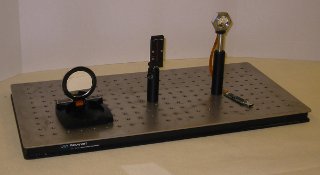
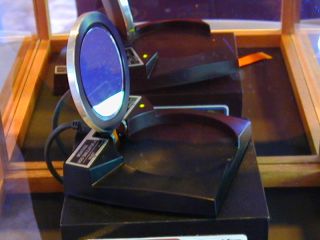
The MONTAGE (Multiple Optical Non-Redundant Aperture Generalized Sensors) program is sponsored by the Defense Advanced Research Projects Agency (DARPA) under the Microsystems Technology Office (MTO). Program managers are Dr. Ravindra Athale and Dr. Dennis M. Healy, Jr. DARPA's MONTAGE web site notes. Recent advances in technologies for optical wavefront manipulation, optical detection, and digital post-processing have opened new possibilities for imaging systems in the visible and IR regimes, suggesting the development of imaging systems which differ dramatically in form fit and function from time-honored camera designs. The MONTAGE program seeks to develop and demonstrate truly revolutionary imaging systems obtained by intelligent integration of the advancing capabilities of the individual optical, detection, and processing subsystems. This integration will exploit recent advances in system optimization methods, which provide an emerging capability for co-design and joint optimization of the optical, detection, and processing aspects of imaging systems.
Distant Focus managed the design, construction, and integration of hardware for the DARPA sponsored MONTAGE program. Our Phase 1 challenge was to showcase the novel optical architectures and revolutionary design optimization paradigms developed by our team.
Phase 1
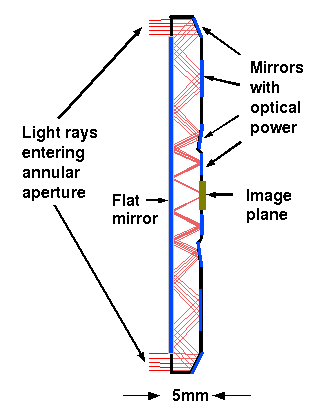
Cross section of folded lens.
Folded Optic
As illustrated in the figure to the right, the MONTAGE demonstrator's architecture differs significantly from a traditional telescopic camera design. An ultra-thin telescopic lens mounts with a conventional 3 mega-pixel CMOS sensor integrated as a vertically aligned disk. The diagram of the innovative UCSD folded optic design above illustrates how the 40mm focal length annular aperture lens is compacted to fit within the 5mm thick volume. The aspheric optical element was fabricated in a diamond machined surface on CaF2. In addition, wavefront corrections were applied to one of the optical surfaces to reduce the longitudinal dependence of the point spread function. Using multi-domain optimization (MDO) techniques developed by CDM-Optics a post-processing step improves the depth of field and increases the tolerance to manufacturing uncertainties. Distant Focus has licensed the folded optic technology from UCSD. Please see our folded optics page for more details.
Electronics and System Integration
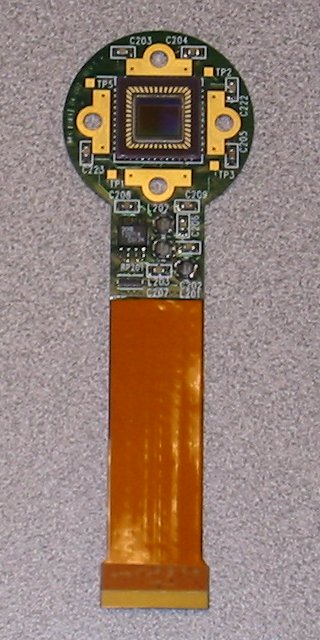
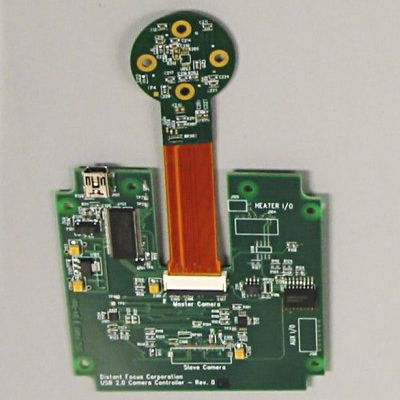
This figure shows the sensor board connected to the USB communications board. The sensor board is actually a rigi-flex PCB; half rigid and half flex.
The demonstrator platform base houses a dedicated USB interface controller that provides interconnectivity to additional computing resources. Distant Focus was responsible for designing the electronic circuit boards; developing firmware and software application interface; designed the packaging; and finally, assembling and testing the combined optical, sensor, and processing system.
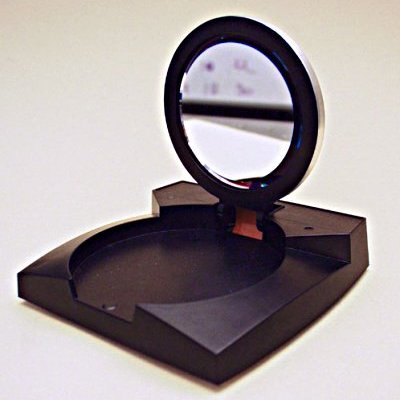
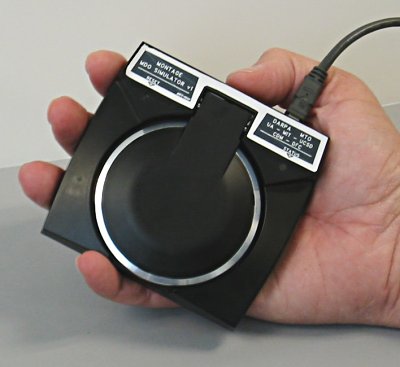
The assembled MONTAGE camera. This figure shows an open and closed camera illustrating the finished injection molded enclosure.
Experimental Results
The following images are created from actual camera data from the non-wavefront coded camera, i.e. the traditional folded design. Since the raw data from the camera was in Bayer format, linear interpolation was performed to create these RGB and monochrome images as the case may be.
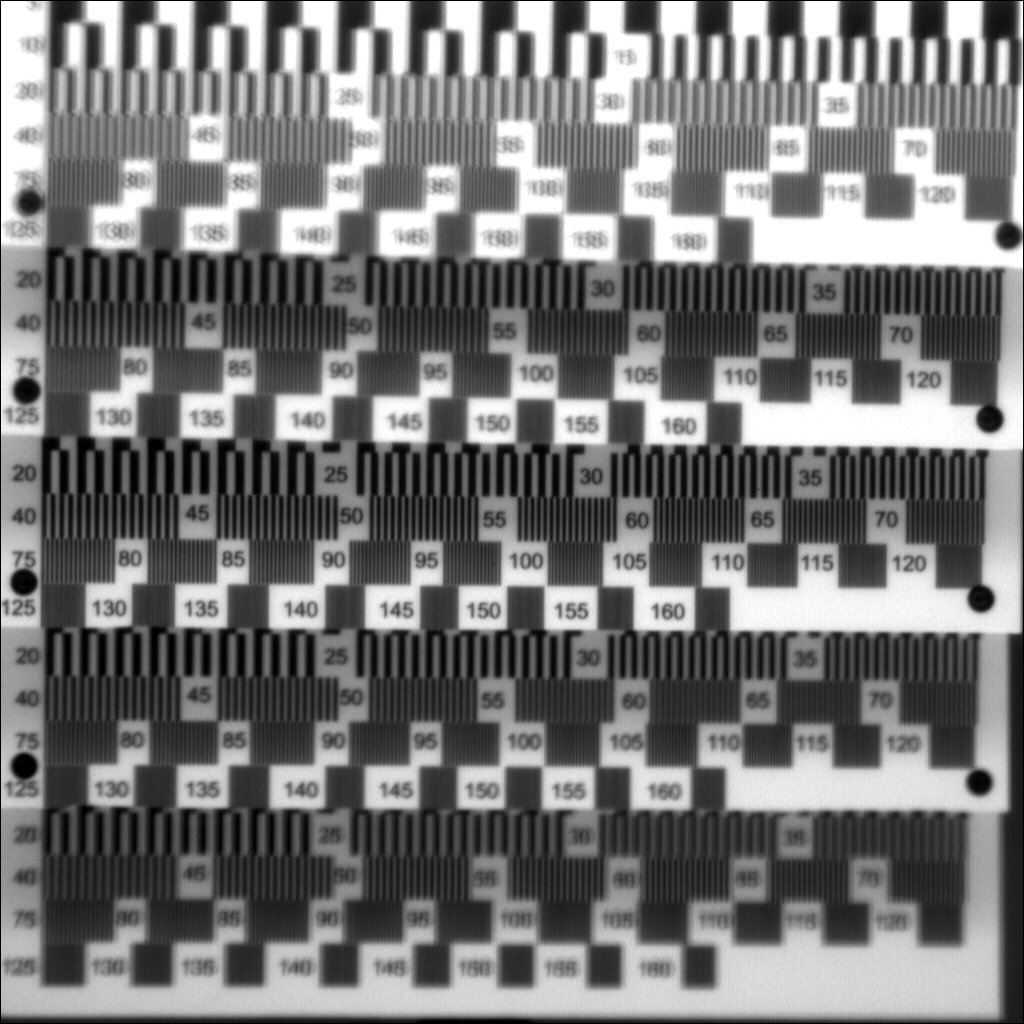
Actual image from MONTAGE camera of resolution targets at different depths. This images shows the very small depth of field associated with a camera having an F/# of 0.7. Stopping down the aperture increases the depth of field as in any normal camera. |
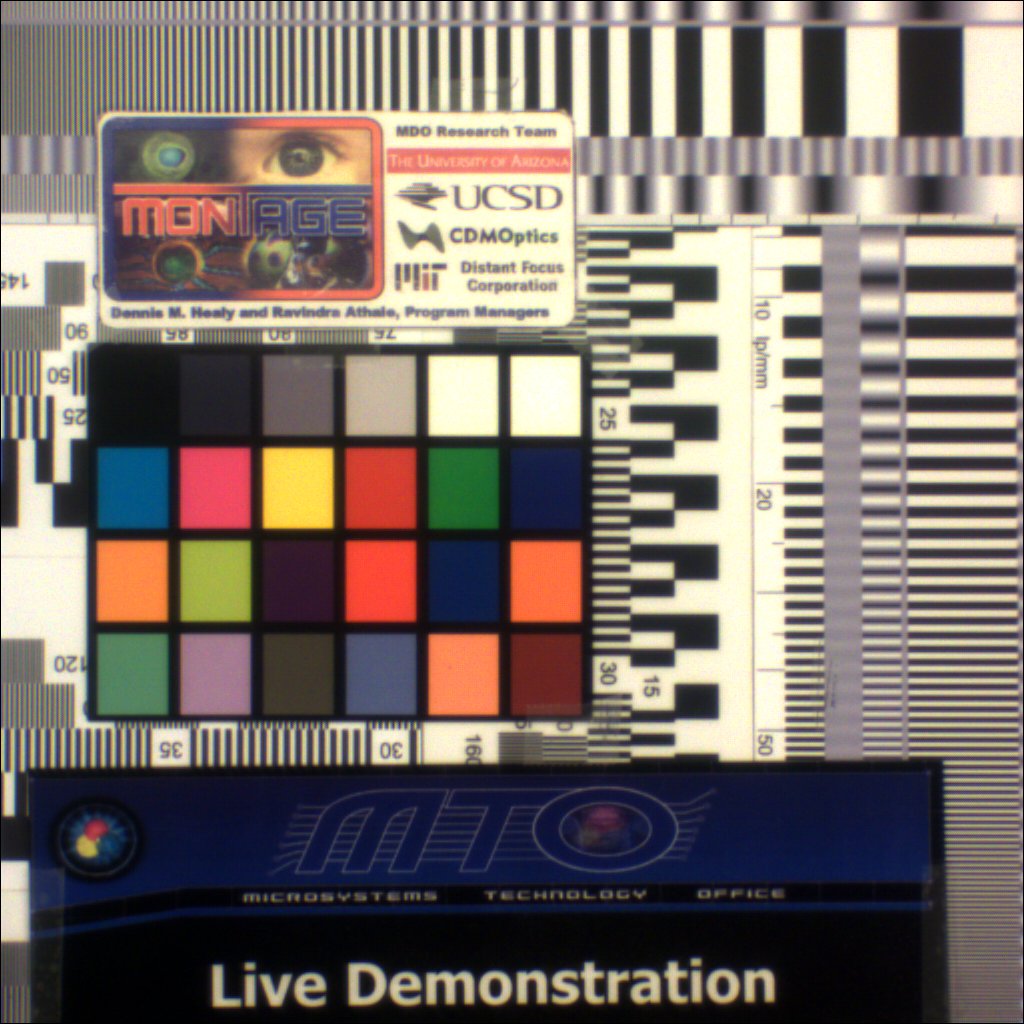
Image showing typical color response of the MONTAGE camera. The folded lens was chromatically corrected for the visible and gives very similar results to that of a conventional camera. |
Phase 2
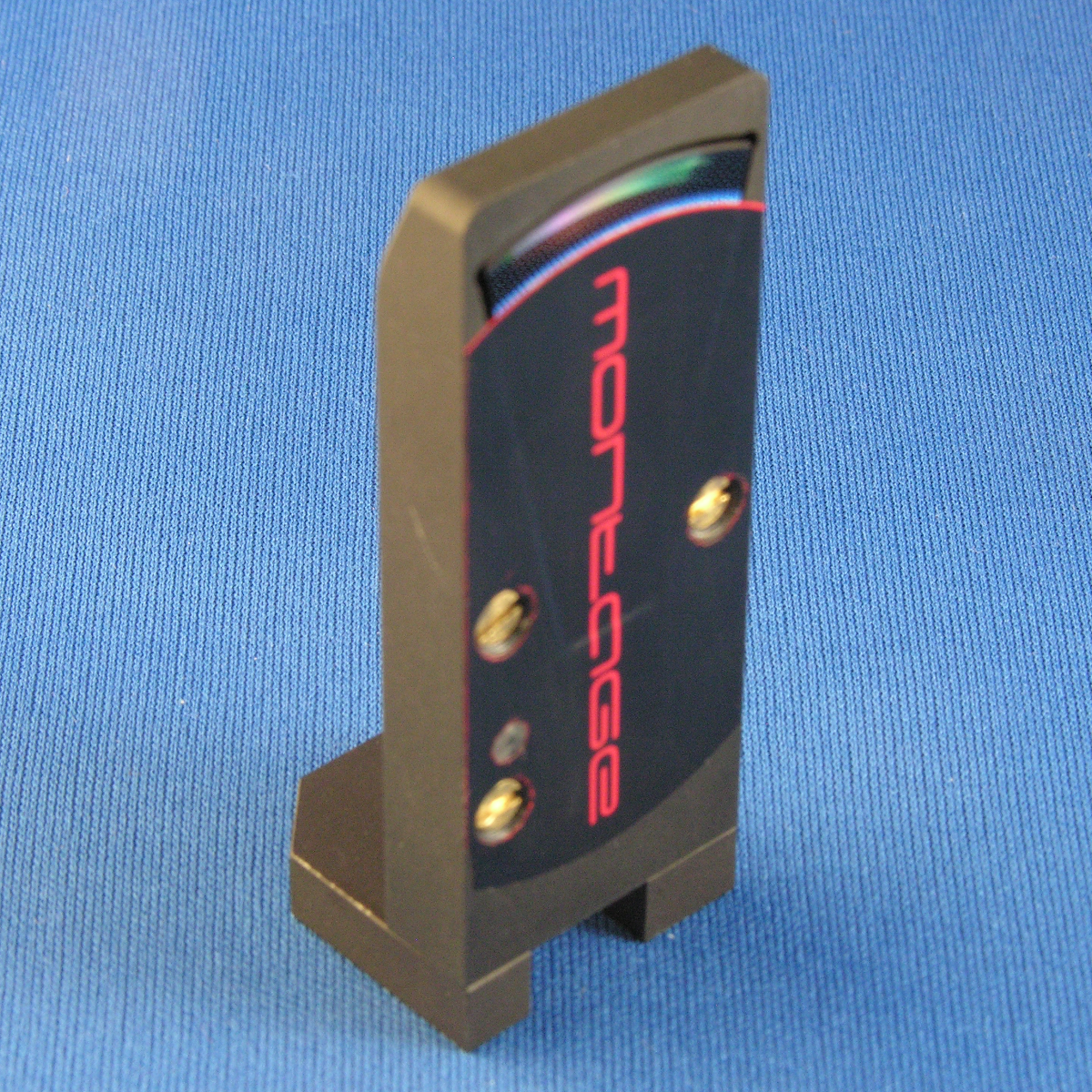
The assembled MONTAGE NANO, an 8-fold sectioned imager.
MONTAGE Phase 2 was a continuation of our work in Phase 1 and consisted of three camera systems, the Nano, the Quad, and the Quad cluster. Each system either illustrated a particular design aspect of ultra-thin cameras or improved some aspect of our Phase 1 camera.
Nano
The Nano was a sectioned version of the Phase 1 8-fold camera to improve the depth of field. Sectioning the lens into a small slice reduces the light throughput of the camera. Improving the reflector coatings and using a sensor with better wide angle pixel response allowed us to make up for most of the loss. Also, unlike the original 8-fold camera this design includes mechanical focus via the 3 adjustment scews shown in the pictures. This provides tip-tilt and z translation of the circuit board that the image sensor is mounted to resulting in a less complicated assembly process.
The Nano required a completely new circuit board assembly due to the small form factor. However, we were able to use the same USB interface chip in a smaller package allowing us to make use of all the software and firmware developed in Phase 1. In addition to Phase 1 software, we developed a Python based GUI in Phase 2 called MDOSim that interfaced with the Nano to allow camera control and image capture. MDOSim was used extensively in MONTAGE and in several subsequent projects.
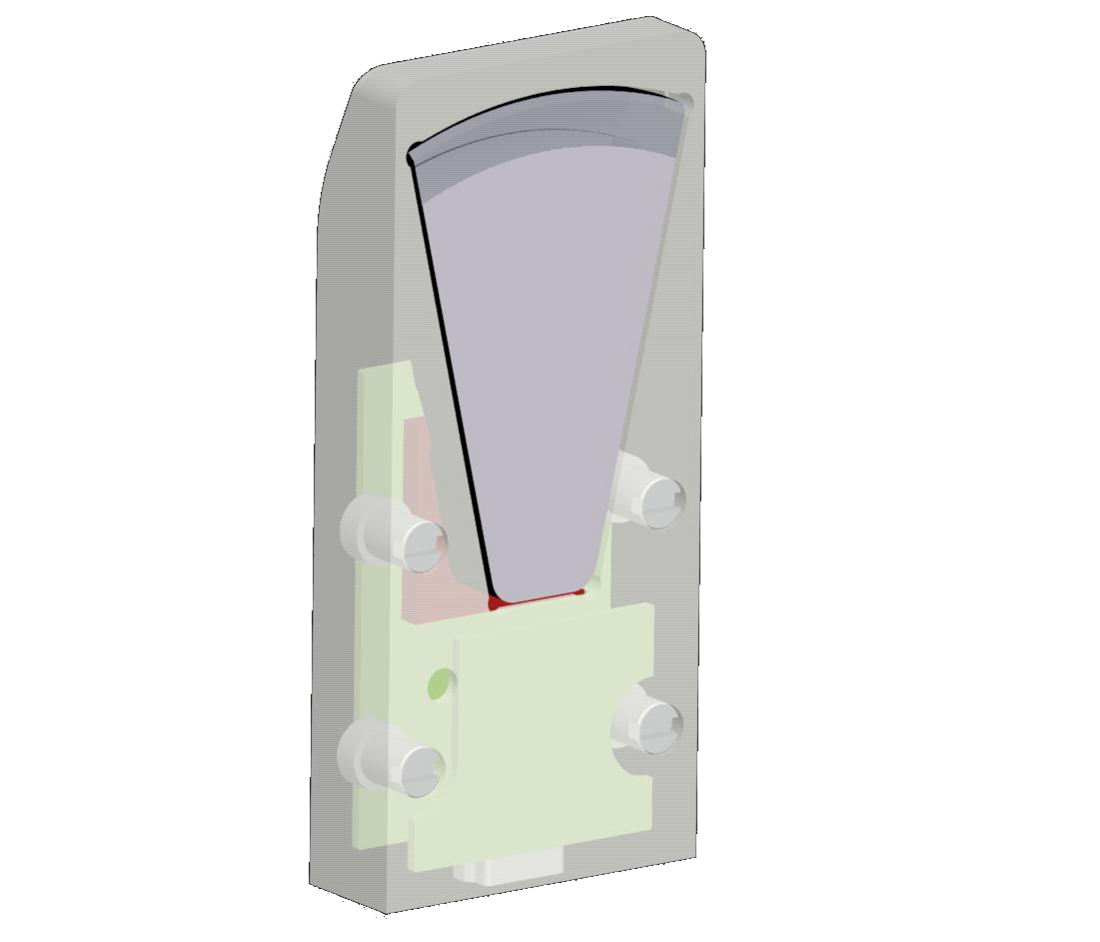
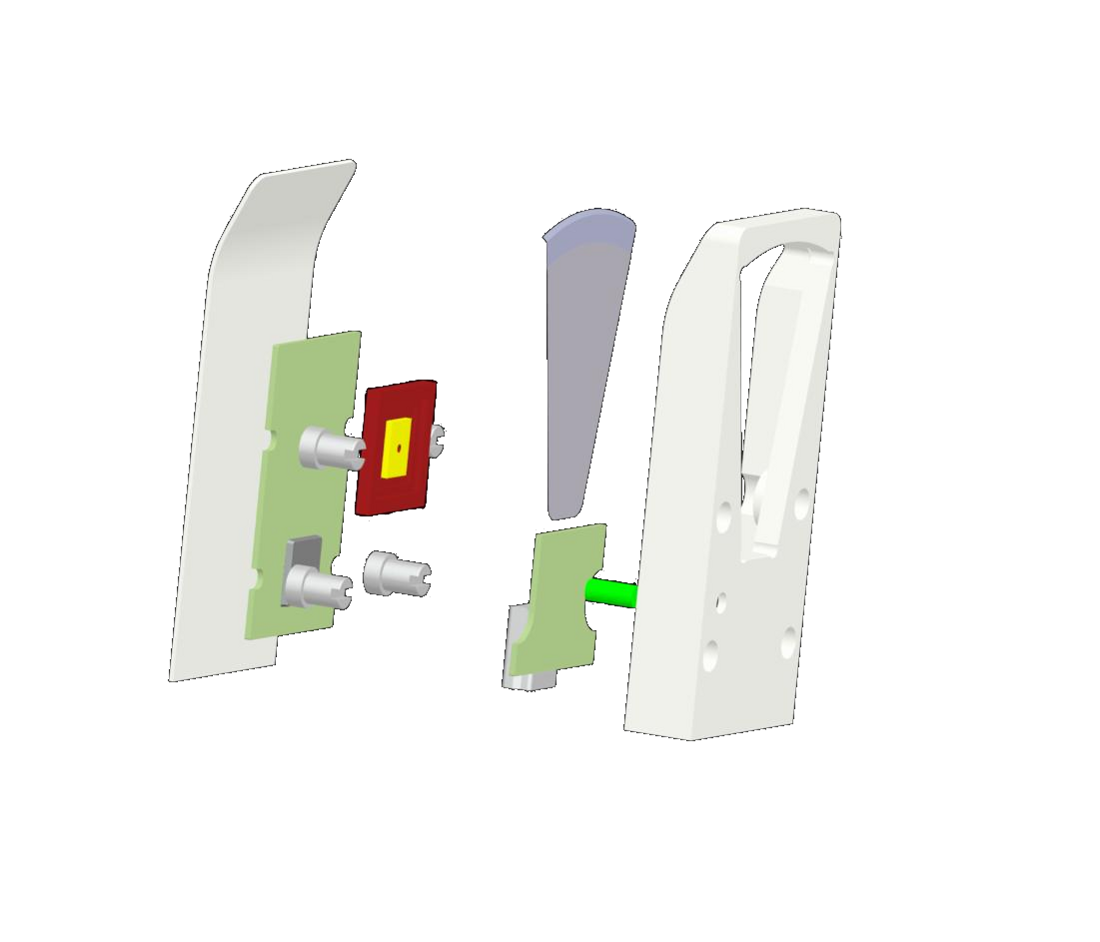
A CAD model of a sectioned 8-fold camera we call the Nano.
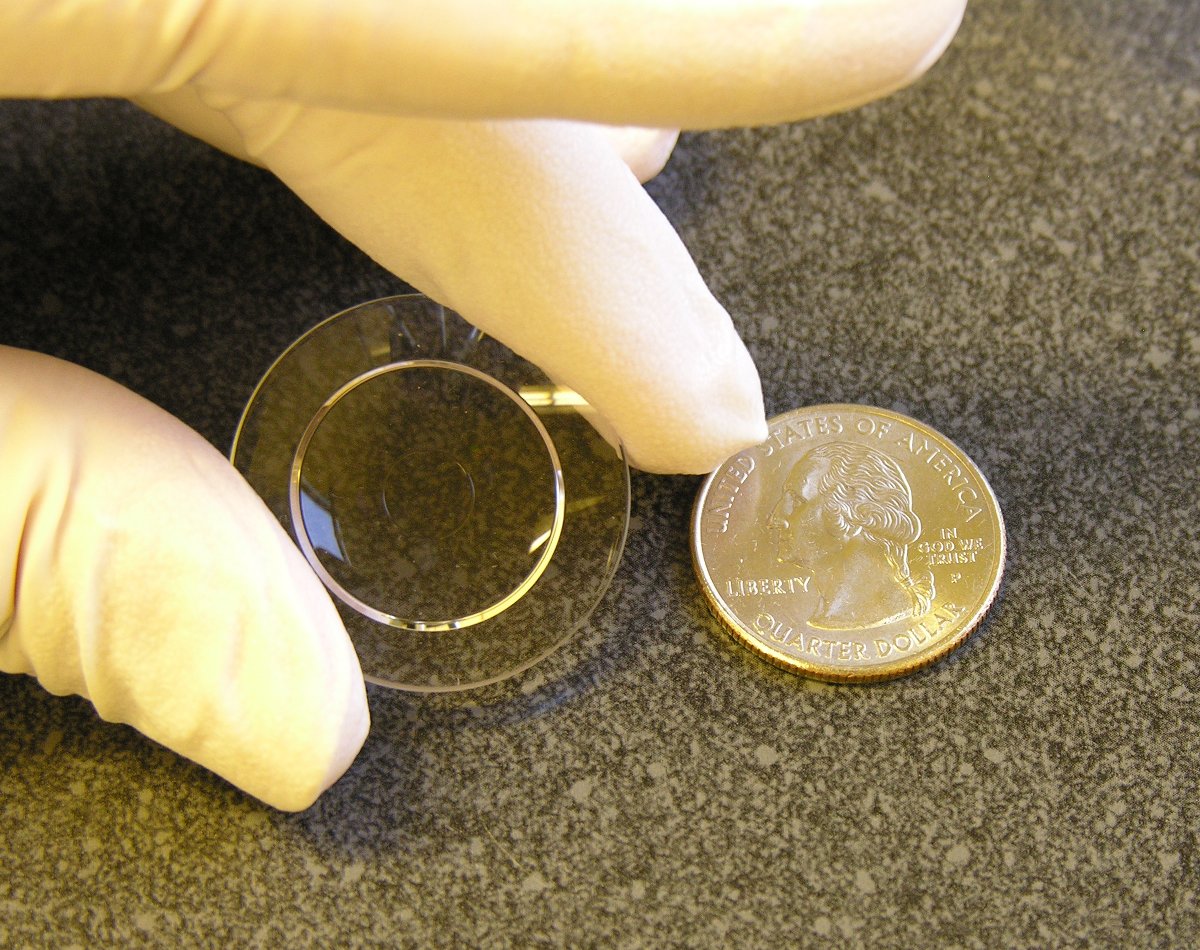
This figure shows the uncoated rear lens of the Quad next to a quarter.
Quad
The Quad camera was a completely new design and resulted from lessons learned in Phase 1. This camera is a 4-fold design but unlike the 8-fold cameras aspheric optical surfaces are on both the front and back sides of the lens. On the 8-fold design just the back surfaces had optical power and the front surface was a flat reflector. The change required that the lens was split into front and back halves to reduce the manufacturing risk. The two halves are coupled together using optical coupling gel. While this added some complexity it was also an opportunity to use the front and back separation to perform focus. Looking at the exploded view of the camera one can see that the back lens is mounted in a carriage that is positioned via a large diameter threaded focusing gear. The sensor and custom circuit board is mounted to this carriage such that it moves as a single assembly. The focusing gear is pulled up against a flat surface on the outer enclosure by four springs as shown. The optical coupling gel proved to be the biggest challenge as it did not flow easily when separating the lenses creating voids.
Like the Nano, the Quad required custom electronics. A sensor circuit board was designed with just enough circuitry to power the sensor and serialize the data for transmission to a secondary interface board. For initial testing this interface was based on our now well tested USB design requiring minimal new software development allowing for rapid development and testing.
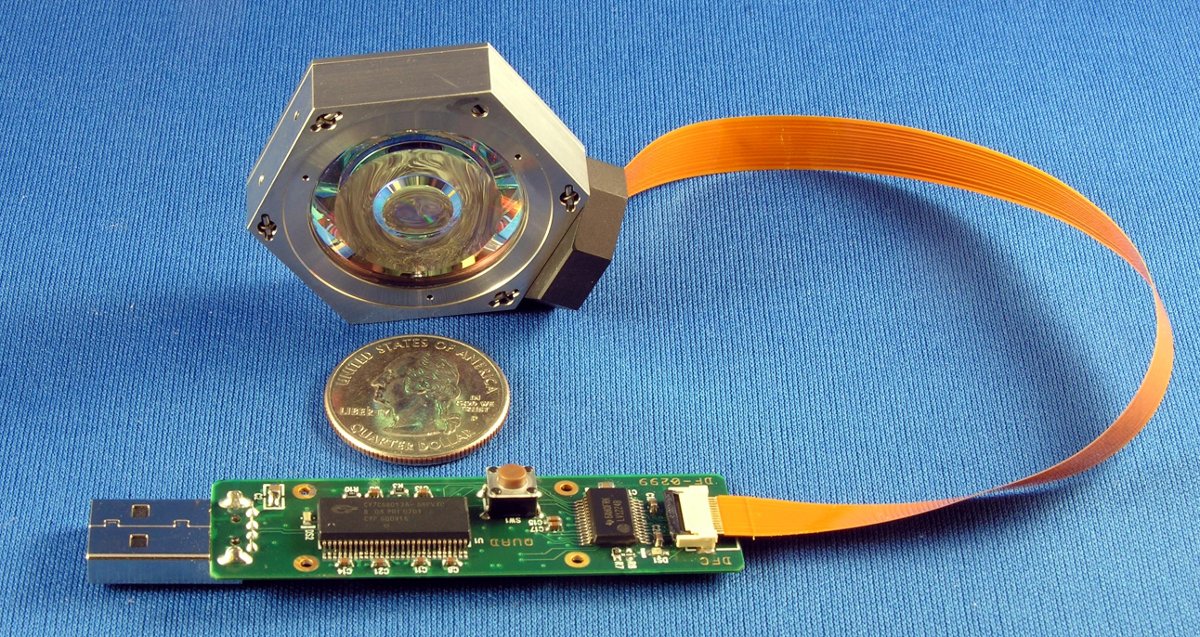
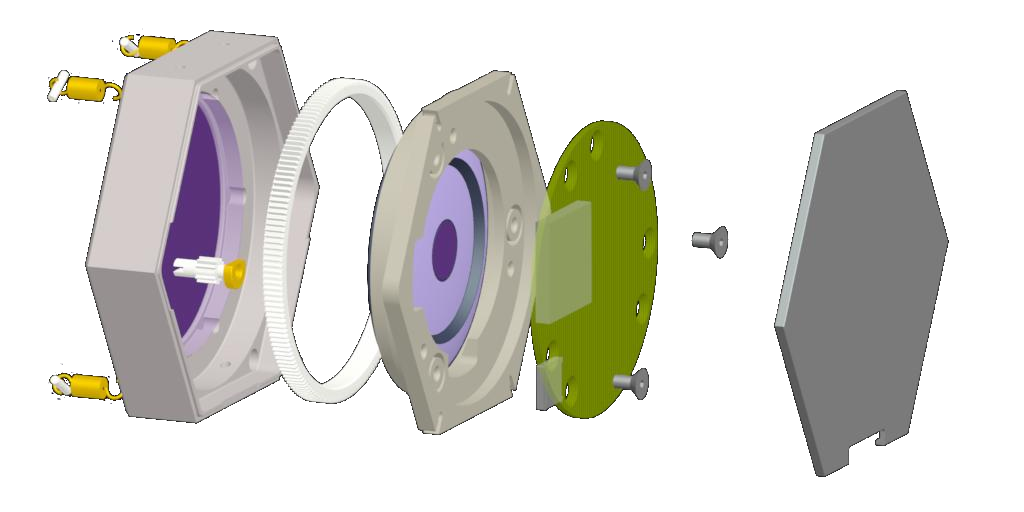
The image on the left shows the Quad camera connected to a custom USB interface. The right image is the exploded view of the Quad camera.
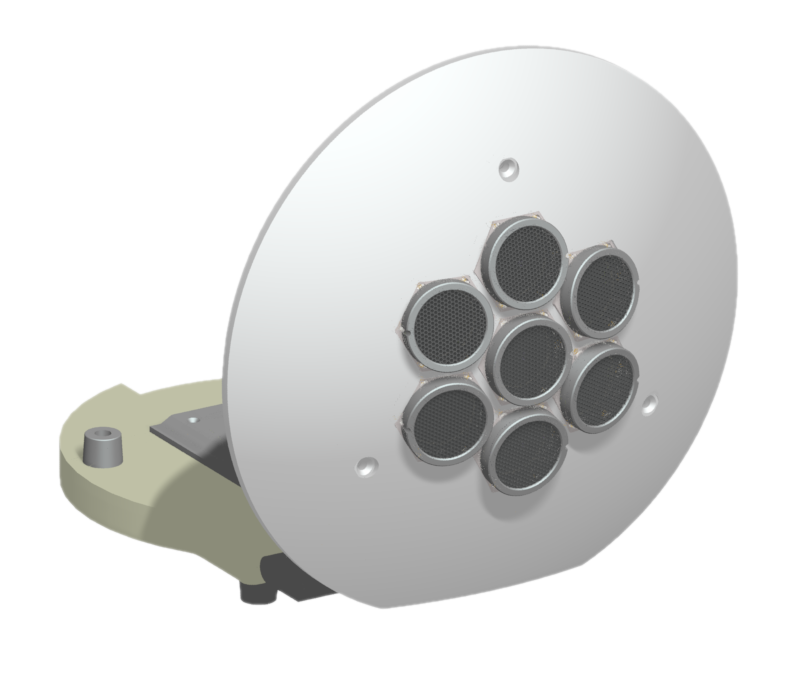
A solid model of the Quad Cluster testbed. The large base is simply to provided mechanical stability but also houses a circuit board where each Quad plugs in.
Quad Cluster
The Quad Cluster concept showed off how one might create a very thin conformal camera with a wide field of view. This was done by tiling seven Quad cameras onto a spherical surface and using custom hardware to perform real time image processing to present a seamless wide field image to the end user.
The majority of the development effort for this part of the project was focused on the "Vision Engine", a custom dual Virtex 4 FPGA board designed to receive data from 7 sensors and do real time lookup table based stitching of image date and display the final composited image on an attached DVI monitor. The user would have the ability to zoom and pan around the full image. The Vision Engine also had our standard USB interface allowing staged development of the firmware. In early testing all the data to be transfered over USB to a PC where processing was done. This allowed our algorithm and hardware teams to be working independently and provided additional flexibility for other applications.
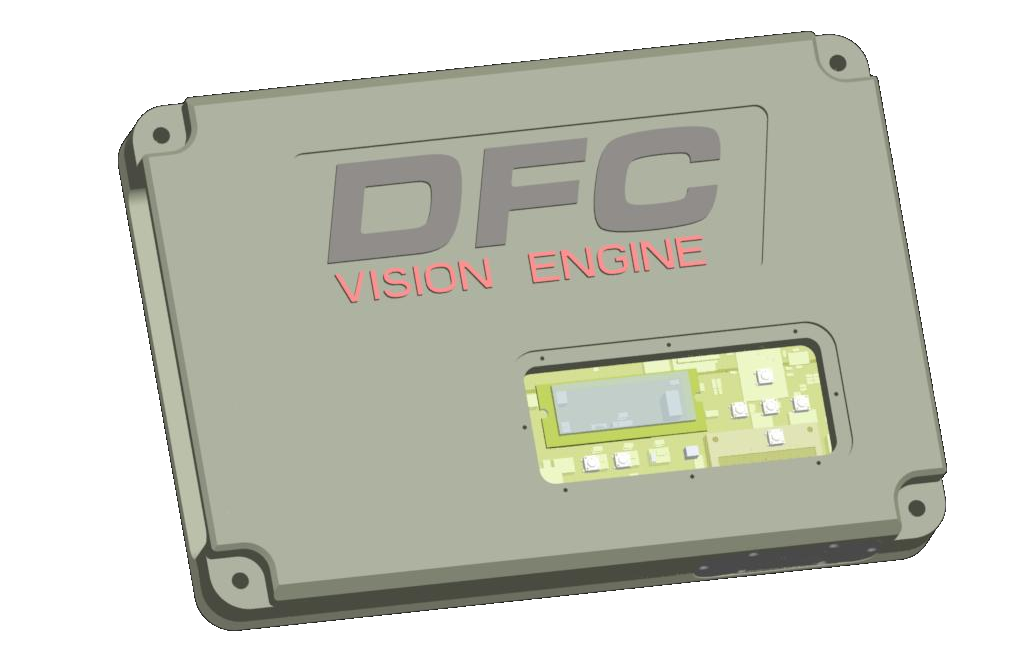
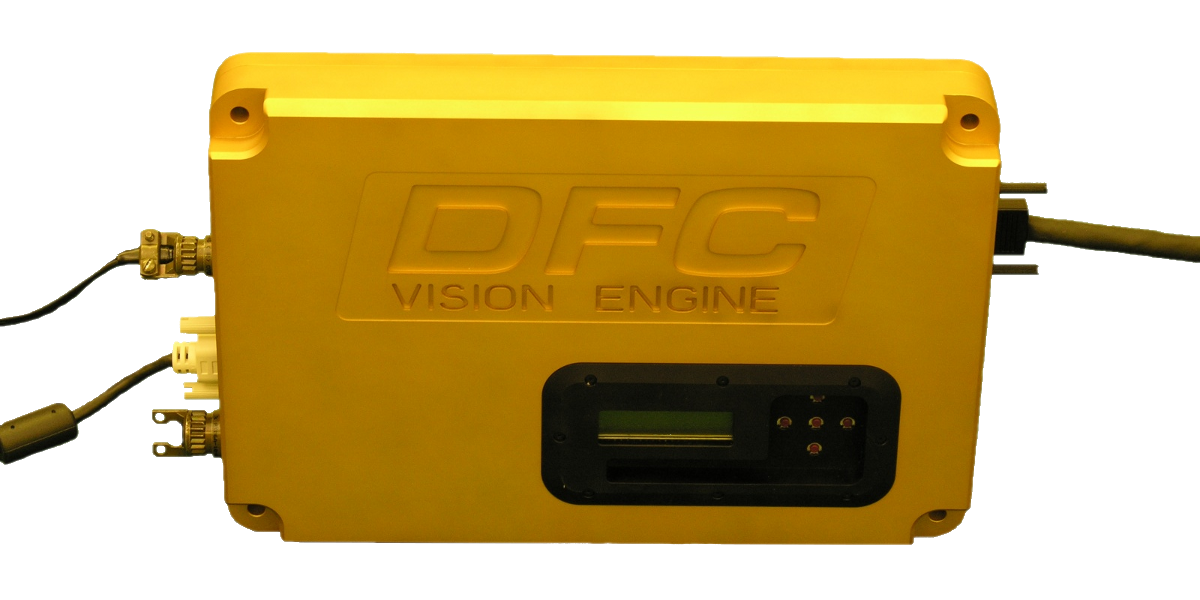
On the left is a solid model of the Vision Engine. The right image is an actual assembled unit, the enclosure is anodized Al.
More Information
For additional information regarding the MONTAGE program download this Information Packet or visit the following web sites: